Why Do EB Systems Generate Ozone? Ozone Removal in Tire Manufacturing
Why Do EB Systems Generate Ozone?
Ozone Removal in Tire Manufacturing
Electron beam (EB) technology is being used in an increasing number of tire manufacturing projects, particularly for rubber modification, pre-vulcanization and other material treatment processes.
From a production point of view, the advantages of EB technology are fairly clear. It can improve process efficiency and help manufacturers develop new approaches to rubber processing.
But there is another part of the system that needs attention:
EB operation can generate ozone.
For an engineer working on an EB installation, the important questions are not simply whether ozone is generated.
They are:
· How much ozone is produced?
· Where does it accumulate?
· How should it be exhausted?
· Does the exhaust require additional ozone treatment?
These questions should be considered when the EB equipment and ventilation system are designed.
Why Does an EB System Generate Ozone?
When high-energy electrons interact with air, they can affect oxygen molecules and generate reactive oxygen species. Ozone (O₃) is one of the resulting products.
In simple terms:
O₂ + high-energy radiation → reactive oxygen species → O₃
The amount of ozone generated depends on the actual operating conditions of the EB system. Beam energy, beam current, equipment power, air volume and operating time can all have an influence.
This is why ozone is a normal engineering consideration for industrial electron beam equipment.
The issue is not limited to laboratory equipment.
Public environmental assessment documents for several tire manufacturing projects in China identify ozone as a by-product of EB operation and include dedicated exhaust ventilation.
For example, a publicly available project involving an EB500 accelerator at a tire manufacturing facility identifies ozone and nitrogen oxides as gaseous by-products and includes an exhaust system for the irradiation area.
This provides a useful reference for understanding how ozone control is handled in an actual tire manufacturing environment.
Why Is Ozone Control Important in a Tire Factory?
An EB system in a tire plant is normally part of a continuous production process.
It may operate for extended periods rather than only during occasional laboratory testing.
That means ozone can also be generated continuously.
The irradiation area is usually enclosed or partially enclosed. If the air is not exchanged effectively, ozone can accumulate around the equipment.
For this reason, local exhaust ventilation is normally the first step in EB ozone control.
A typical arrangement is:
EB Equipment → Local Exhaust → Ductwork → Outdoor Discharge
The purpose is straightforward:
Keep ozone from accumulating around the irradiation area.
Exhaust Ventilation Is Not the Same as Ozone Destruction
This distinction is important.
An exhaust system moves ozone-containing air away from the EB equipment.
An ozone destruction system reduces the ozone itself.
For example, an EB installation may collect air from the irradiation chamber and discharge it through an exhaust stack.
If the resulting discharge meets the applicable requirements, this may be a suitable solution.
But the ozone has not actually been removed from the exhaust stream. It has simply been transferred from the equipment to the exhaust system.
That leads to a more important engineering question:
Does the exhaust need additional ozone treatment before discharge?
There is no single answer for every EB installation.
The decision depends on factors such as:
· EB equipment power
· Ozone generation rate
· Exhaust airflow
· Ozone concentration
· Exhaust location
· Plant layout
· Local environmental requirements
In other words, ventilation and ozone destruction should be evaluated as two connected but different functions.
What Does an Ozone Destruction System Do?
The basic purpose of an ozone destruction system is to decompose ozone into oxygen.
In simplified form:
O₃ → O₂
Depending on the application, ozone can be treated using catalytic decomposition or other suitable technologies.
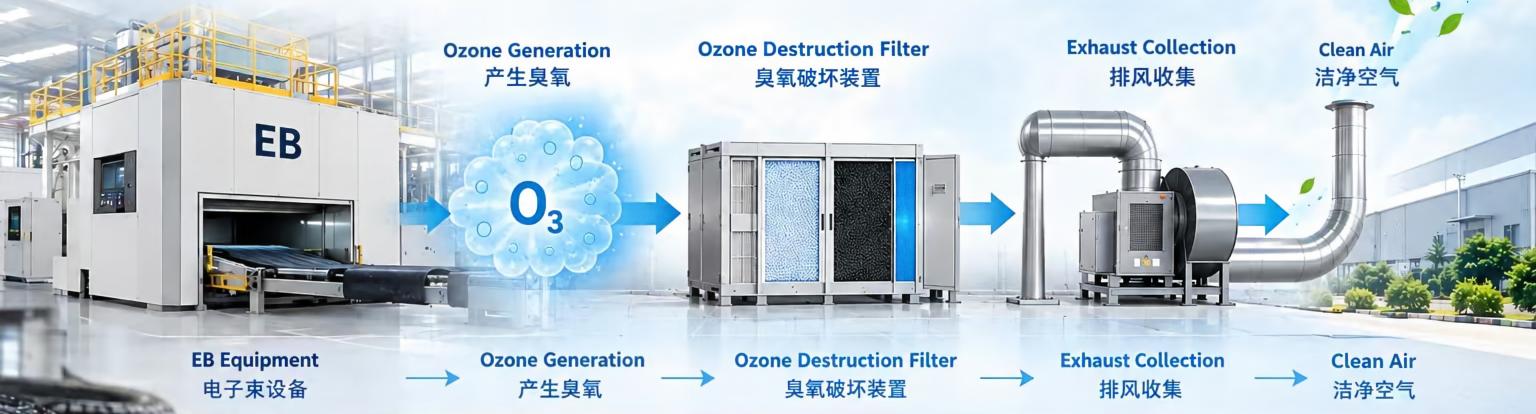
For an EB installation, the overall process may look like this:
EB Equipment
↓
Ozone Generation
↓
Exhaust Collection
↓
Ozone Destruction
↓
Treated Air
↓
Discharge
The ozone destruction unit does not replace the ventilation system.
The two systems work together.
The ventilation system controls airflow and prevents ozone from accumulating around the equipment.
The ozone destruction unit treats the ozone in the collected exhaust.
Where Can Ozone Destruction Be Useful in Tire Manufacturing?
Not every EB installation requires the same ozone treatment configuration.
However, there are several situations where additional ozone destruction may be worth considering.
1. High-Power EB Equipment
Higher-power electron beam systems can produce a larger ozone load.
The ozone treatment system therefore needs to be sized according to the actual process rather than simply selecting a standard filter size.
2. Long Operating Hours
If an EB system runs continuously, ozone generation is continuous as well.
The treatment system therefore needs to maintain stable performance over long operating periods.
3. Exhaust Outlets Near Working Areas
Plant layout can make a significant difference.
If an exhaust outlet is located close to operators, production areas or fresh-air intakes, additional ozone treatment may be useful.
4. New EB Lines and Plant Expansion
Ozone control is easier to integrate when an EB line is being designed or installed.
Adding treatment equipment later can require changes to ductwork, fans, space allocation and controls.
5. Higher Environmental Requirements
Some facilities may be able to manage ozone through ventilation and controlled discharge.
Other plants may prefer additional treatment to reduce ozone concentration before discharge.
The appropriate approach should be determined from the actual project conditions.
Don’t Choose an Ozone Filter Based Only on “99% Removal Efficiency”
This is one of the most important points when selecting an ozone destruction filter.
Industrial ozone-control products are often described using figures such as:
“≥99% ozone removal efficiency.”
The number sounds impressive, but by itself it does not tell an engineer enough.
A proper evaluation should also consider:
· Inlet ozone concentration
· Airflow
· Temperature
· Relative humidity
· Pressure drop
· Operating hours
· Catalyst service life
· Other contaminants in the exhaust
For example, removing 99% of ozone from an inlet concentration of 0.1 ppm is very different from removing 99% from 10 ppm.
The more useful question is:
At our actual airflow and ozone concentration, what ozone concentration can the system achieve at the outlet?
That is much more meaningful than looking at removal efficiency alone.
What About VOC, Oil Mist and Other Contaminants?
An EB exhaust system in a tire factory is not necessarily handling clean air.
Depending on the location and surrounding production processes, the exhaust may contain or be affected by:
· VOCs
· Oil mist
· Rubber-related vapors
· Dust
· Moisture
· Nitrogen oxides
These contaminants can affect ozone catalyst performance and service life.
For this reason, an ozone destruction filter should not be selected based only on the ozone concentration.
The condition of the entire airstream needs to be considered.
This is particularly important when the ozone destruction system is expected to operate continuously as part of a production line.